The Phone Call I Get Every Week
“Hey Doc, Murphy started limping yesterday. He’s not crying but he won’t put full weight on the back leg. Do I need to come in today or can it wait?”
That question lands in my inbox or on the reception line several times a week. Limping is one of the most common reasons dogs show up in the exam room, and also one of the easiest things for the internet to turn into a five-alarm emergency. Cruciate rupture. Bone cancer. Neurological disaster. The differential list online is long and terrifying.
In the real exam room the process is quieter and more systematic. Most of the useful information arrives in the first sixty seconds—before I reach for any instruments, before we talk money, before anyone panics. Here is exactly what I am looking at, in order, and why each step matters.
Second 0–10: The Entry and the Stand
I watch the dog walk into the room or, if he is carried, how he stands once he is on the floor.
Is the limp consistent or intermittent?
Is he toe-touching, holding the leg completely off the ground, or just shortening the stride?
Does he shift weight the moment he stops, or only when he moves?
Is the head bobbing (front-leg limp) or is the hip hiking (back-leg limp)?
This ten-second movie tells me more than most owners realize. A dog that walks in with a mild, weight-bearing limp and then stands square is a different case from the dog that refuses to let the toes touch the floor. I am already sorting soft-tissue strain from possible fracture or severe joint issue before I ever touch him.
Second 10–25: The Hands-On Survey While He Is Standing
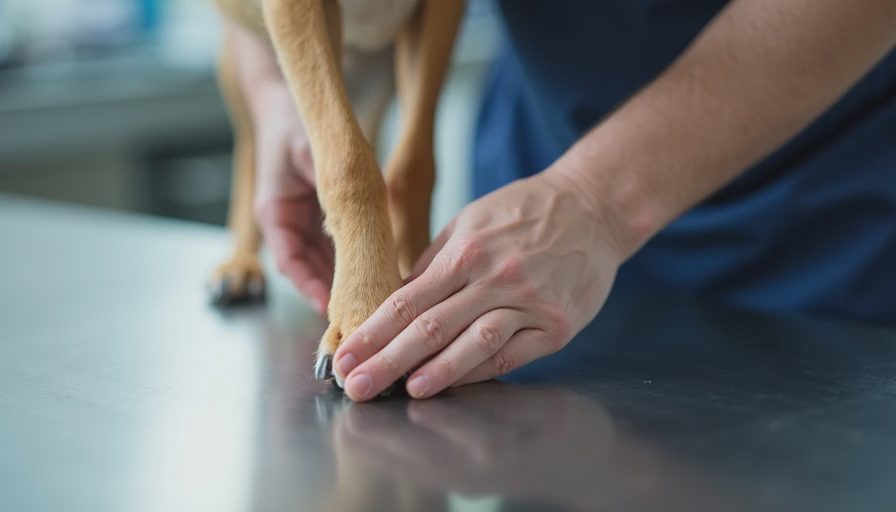
I run both hands over the dog while he is still standing, starting at the head and moving back.
I feel for heat, swelling, or asymmetry in the shoulders, elbows, carpi, hips, stifles, and hocks.
I check muscle mass over the spine and thighs—chronic problems often show up as one-sided muscle loss long before the owner notices a limp.
I look at the paws: broken nails, pads that are worn unevenly, foreign material stuck between toes, swelling around a dewclaw.
Most owners are watching my face for a reaction. I am watching the dog’s face and the subtle weight shifts. A dog that leans away when I touch one shoulder has already told me where to focus.
Second 25–40: The Gentle Manipulation
Still standing, I pick up each front foot and flex the carpus and elbow through a normal range. Then I move to the back legs—flex the hock, the stethoscope, the hip. I am not trying to produce pain; I am feeling for restriction, crepitus, or the dog’s reaction.
The classic cranial drawer or tibial thrust test for cruciate ligament disease comes later if needed. In the first minute I am only asking: Does this joint move the way its partner moves? Does the dog guard before I even reach the end of the normal range?
If the dog is very painful or fractious, I stop. There is no prize for completing the exam on a dog that is telling me it hurts too much. We can use sedation or a calmer moment later.
Second 40–55: The Sit, the Down, and the Neurological Glimpses
I ask the dog to sit and then, if he is willing, to lie down.
A dog that sits with one leg kicked out to the side is giving me classic cruciate information.
A dog that is reluctant to lie down or struggles to get up may be pointing me toward hips, lower back, or systemic pain.
While he is down I run a quick conscious proprioception check—flipping the paw over gently to see how quickly he rights it. Delayed responses push me toward neurologic differentials.
These are not full neurologic or orthopedic exams. They are triage. They tell me whether we are mainly in soft-tissue and joint territory or whether I need to keep spinal disease and nerve issues on the list.
Second 55–60: The Conversation That Matches the Chart
Only now do I turn fully to the owner with the first round of questions that matter:
When did you first notice it?
Did it appear after a specific event—rough play, a fall, a big hike—or did it creep in?
Is it better or worse after rest? After activity?
Any licking at a particular joint or paw?
Any other symptoms—fever, decreased appetite, more time spent sleeping?
The answers either support the mechanical story the body just told me or open a second chapter (Lyme disease, soft-tissue infection, early immune-mediated disease, etc.).
What Usually Comes Next (and What Does Not)
In a large percentage of mild, acute, weight-bearing limps with no obvious instability or severe pain, the next step is controlled rest, anti-inflammatory support if appropriate, and a recheck in seven to ten days. We do not jump straight to radiographs or advanced imaging on every limping dog. Imaging is a tool, not a reflex.
If the history and exam raise red flags—non-weight-bearing, significant swelling, crepitus, neurological deficits, fever, or a dog that is simply too painful to examine well—we move faster. Radiographs, bloodwork, or referral enter the conversation based on findings, not on fear.
I always lay out the ladder:
Here is the affordable, low-intervention path and what would make us climb higher.
Here is the more aggressive path if you want maximum information today.
Then we decide together.
The Part Owners Can Do Before They Even Call
You can run a shorter version of this sixty-second survey at home. Watch the gait on a non-slip surface. Feel for heat or swelling. Check the paws. Note whether the limp is better or worse after rest. Take a clear video from the side and from behind. That information makes the actual appointment faster and more precise.
Limping is common. Catastrophic causes exist but are not the majority of what walks through the door. The first sixty seconds exist to separate the routine from the urgent so we can treat the dog in front of us instead of the worst-case scenario on the internet.
Next time your dog takes an uneven step, you will know at least the first questions I will be asking with my eyes and hands. That knowledge alone usually lowers the temperature in the room.
Let the chart—and the first sixty seconds—do the talking.



No letters yet — be the first to write.