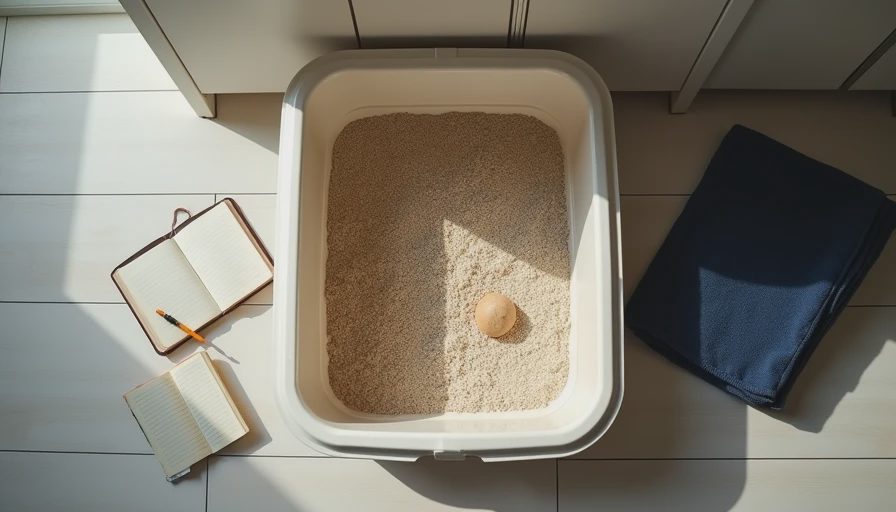
The Most Under-Used Health Record in the House
Most cat owners can tell me what brand of food they buy and whether the cat slept in the sunbeam today. Far fewer can tell me, with any precision, what the litter box looked like this morning compared with last week.
That is a missed opportunity. The litter box is the closest thing most cats give us to a daily lab report. Urine volume and color, stool quality and frequency, straining, vocalizing, or sudden changes in preference—all of it shows up there first. By the time a cat is clearly sick in the living room, the box has often been trying to tell us something for days or weeks.
After sixteen years of asking the same questions and hearing “I think it’s normal?” I started teaching clients a simple way to read the box on purpose. It takes almost no extra time once it becomes habit, and it catches problems while they are still easy to treat.
What “Normal” Actually Looks Like
Every cat is an individual, but useful baselines exist.
Urine: Most healthy cats produce a moderate amount of urine once or twice a day in the box. The urine should be clear to pale yellow. Strong ammonia smell after only a few hours can be normal in a covered box; pink, red, or tea-colored urine is not.
Stool: One or two formed stools per day is common. The stool should be firm enough to hold its shape but not rock-hard. Very dark, very light, mucous-coated, or watery stools all deserve attention.
Behavior: The cat should enter the box, eliminate, cover (or not, depending on the individual), and leave without crying, straining, or repeated trips.
Anything that departs from your cat’s personal pattern is information.
The Daily Glance That Matters More Than a Weekly Deep Clean

You do not need to become a litter-box archaeologist. A ten-second look once or twice a day is enough.
Is there a new clump size or number of clumps?
Is the stool the usual size, shape, and color?
Are there signs of straining—small urine spots outside the box, multiple small clumps, or stool fragments?
Is there blood, mucus, or diarrhea?
Has the cat started avoiding the box or using a new location?
That is the entire exam. Note anything that is different. Trends over three or four days are more meaningful than a single odd entry.
Early Warnings the Box Often Gives First
Urinary issues: Increased frequency, smaller clumps, straining, or crying in the box can signal inflammation, crystals, stones, or blockage—especially in male cats. A blocked cat is an emergency; the earlier you notice the pattern, the better the odds.
Constipation or megacolon risk: Hard, dry stools or less frequent defecation show up in the box long before the cat looks uncomfortable in the hallway.
Diarrhea and dietary intolerance: Soft stool or stool with mucus often appears before weight loss or obvious lethargy.
Kidney and systemic disease: Larger urine clumps (polyuria) can be an early clue that the kidneys or other systems are changing.
Stress and interstitial cystitis: Some cats produce blood-tinged urine or eliminate outside the box when stressed, even with sterile urine cultures. The box behavior is still the first flag.
How to Make Observation Easy Without Obsessing
Use a litter that clumps well and is light-colored enough to show blood or unusual colors.
Scoop daily—both for hygiene and so you actually see what is new.
If you have multiple cats, consider a second box or temporary separation if you need to identify which cat is producing which signs.
Take a clear photo of anything unusual. A picture of the clump or stool is more useful to your veterinarian than a vague description two days later.
You are not trying to diagnose. You are trying to notice change early enough that the clinic visit is proactive instead of reactive.
When to Call Instead of Just Watching
Call the same day if you see:
Straining with little or no urine produced
Blood in urine or stool
Repeated unproductive trips to the box
Vocalizing in pain
Vomiting combined with litter-box changes
Sudden elimination outside the box in a previously reliable cat
For milder changes—slightly softer stool for a day, one larger-than-usual clump—note it and recheck the next day. If the change persists or worsens, schedule an appointment and bring your observations.
The Kitchen-Floor Version of This Habit
Pair the litter-box glance with the five-minute monthly checkup you already know. Once a month, while you are feeling ribs and checking gums, also look back at your mental or written notes from the box. Any slow trend in urine volume, stool quality, or frequency becomes obvious when you review it on purpose.
Cats are experts at looking fine until they are not. The litter box is one of the few places they cannot fully hide the evidence. Reading it regularly is one of the highest-value, lowest-cost things you can do for their long-term health.
No special equipment. No advanced training. Just attention paid to the one place your cat already goes every day.
Let the chart—and the litter box—do the talking.



No letters yet — be the first to write.